
EMI3News & insightPractice
Zones, roles and the parallel service
Two trades on one machine at the same time is where servicing time is won or lost. How zone boundaries get drawn, and what happens to turnaround when they are drawn badly.
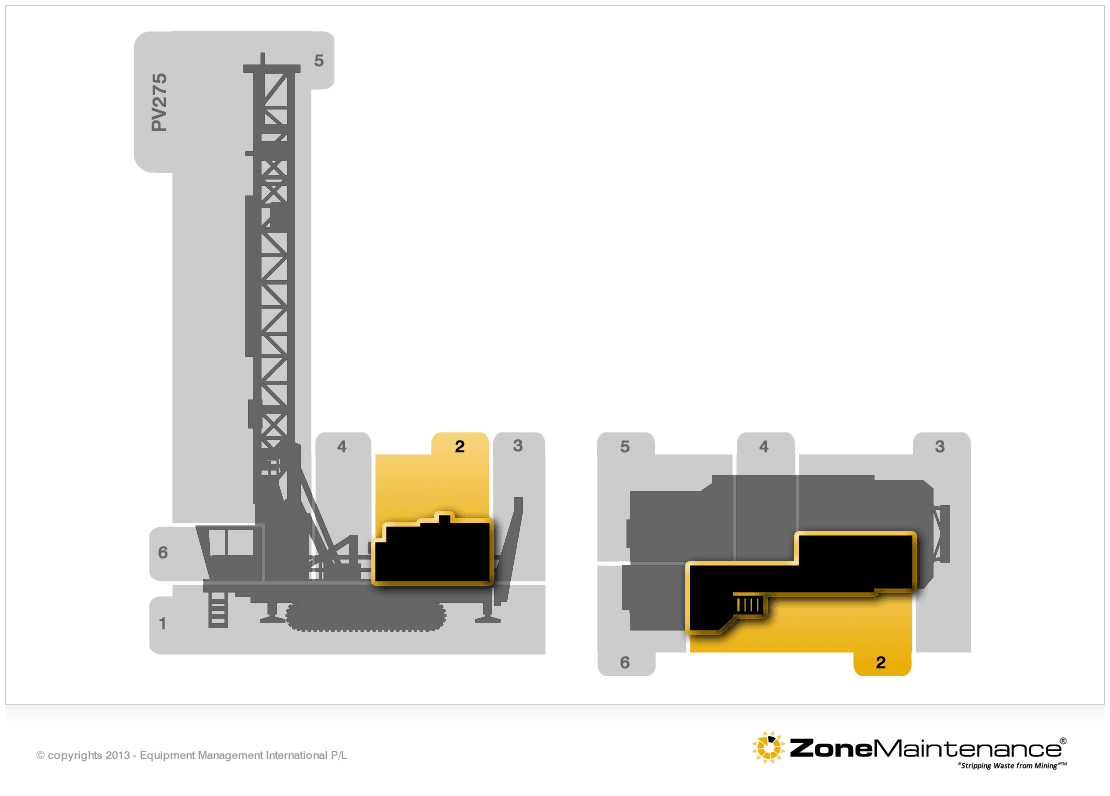
The single largest lever on service turnaround is not how fast anyone works. It is whether two trades can work at once without waiting on each other.
That is a geometry problem before it is a scheduling problem. If the mechanical tasks and the electrical tasks are interleaved through a single list, the two trades collide: over access, over isolations, over the same physical space. Turnaround becomes the sum of both, not the longer of the two.
Drawing the boundary
Zones exist to make parallel work safe and obvious. A well-drawn zone is bounded by physical access, not by system type: everything a person can reach from one position, in one posture, with one set of isolations in place.
Zones are drawn by where a person can stand, not by how the machine is catalogued.
Badly drawn zones fail in a recognisable way. Technicians walk the machine repeatedly, isolations are lifted and reapplied, and the completion data shows two roles finishing at wildly different times on every service. That last signal is the useful one: it is visible in the execution record long before anyone complains.
Get it right and the pit-stop analogy stops being a metaphor. Prepared and ready, relaxed and waiting for the next truck.
Was this useful?
We read every response. It decides what we write next.
We will not add you to a mailing list.
Keep reading
Product
Inside the limits, and still going wrong
A condition monitoring question captures a number and a photograph. The platform trends it across the fleet, watches the rate of change, and raises an alert while the reading is still comfortably inside its limits.
4 September 2026 · 7 min read
Insight
Your CMMS is not the execution layer
Enterprise systems hold the asset record. Planning systems schedule the work. Neither of them sees the work being performed, and that gap is not a reporting problem to be fixed with another dashboard.
12 August 2026 · 8 min read
Insight
Chaos, constrained: why maintenance behaves like a complex system
Small deviations at the start of a shift produce very large differences by the end of it. You cannot remove that sensitivity, but you can bound it, the way aviation and surgical systems do.
29 July 2026 · 6 min read